
Engineering Judgment in the Age of Artificial Intelligence
Engineering Judgment in the Age of Artificial Intelligence
Bringing the Series Back to Engineering Judgment
The first four articles in this series addressed architecture, system boundaries, responsibility, and verification. This final article returns the discussion to daily engineering practice and, more specifically, to Engineering Judgment. The central question is no longer only how Artificial Intelligence fits into system architecture, but what role it should play in the engineer’s own work and how that role affects real technical decisions.
Artificial Intelligence now supports design assistance, simulation review, diagnostics, code generation, pattern detection, optimization, and many other technical tasks. That role is real, and there is no reason to deny it. AI can accelerate work, surface patterns, compare alternatives, and reduce manual effort across many forms of engineering activity.
However, usefulness does not settle the deeper question. Engineering does not consist only of producing outputs quickly. It depends on Engineering Judgment: judging what those outputs mean, whether they are causally sound, and whether they deserve to influence real decisions.
Pattern Recognition Is Not the Same as Causal Understanding
Artificial Intelligence is often strongest at pattern recognition. It can identify regularities, correlations, and probable relationships across large data sets faster than most traditional workflows. In bounded tasks, that capability can be extremely valuable.
However, engineering judgment requires more than recognizing patterns. It requires causal understanding. Engineers must ask what is happening, why it is happening, what assumptions make it true, what conditions limit it, and what consequences follow if those assumptions fail. That is a different intellectual act.
A model may detect that a temperature signature often appears before a fault. The engineer still has to decide whether the temperature caused the fault, merely accompanied it, or reflected some third condition. Without that step, decision-making may become faster, but it does not necessarily become more reliable.
That is the key distinction: pattern inference can support engineering work, but causal reasoning remains essential to engineering judgment.
The Limits of Algorithmic Inference
Algorithmic inference has real value, but it also has limits. It works well in tasks such as classification, anomaly detection, ranking, prediction, and option generation inside a known domain. Yet engineering often demands judgments that reach beyond those functions.
Engineers deal with incomplete information, conflicting evidence, degraded conditions, novel configurations, and consequences that extend beyond immediate data patterns. A recommendation may look statistically plausible while remaining causally weak. A generated solution may satisfy a local metric while creating a broader systems problem. A model may appear strong until the operating context shifts.
In those moments, engineering does not need inference alone. It needs judgment disciplined by causality, constraints, and responsibility. That is why AI can assist decisions without replacing the reasoning that makes those decisions defensible.
Responsibility Still Belongs to the Engineer
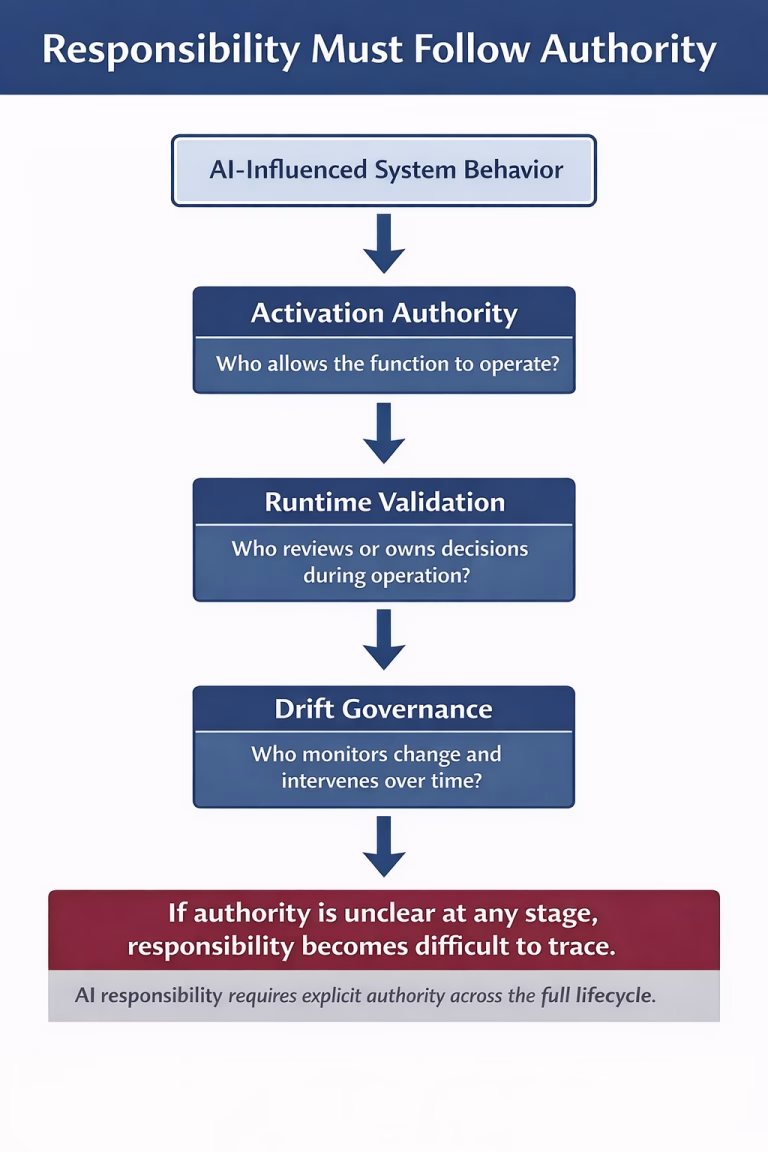
Earlier in the series, the argument about authority made one principle clear: responsibility must remain traceable to decision authority. That same principle applies inside engineering work. If an engineer uses AI to support analysis, diagnostics, requirements drafting, simulation interpretation, or design exploration, the engineer still owns the decision to accept, reject, revise, or further validate the output.
The tool may propose. The engineer must judge.
The tool may accelerate pattern discovery. The engineer must decide whether the result is physically plausible, architecturally consistent, and valid under the intended operating conditions. If that final layer of judgment disappears, AI does not strengthen engineering. It weakens it by replacing responsibility with convenience.
In that sense, AI does not remove human responsibility from engineering practice. It makes disciplined responsibility even more important.
Disciplined Integration Matters More Than Enthusiasm
The right question is not whether engineers should use AI. The more useful question is how they should use it without surrendering causal responsibility.
A disciplined integration model begins with boundaries. Engineers should know what task the AI tool supports, what assumptions underlie its output, what error sources are likely, and what additional review is required before the output influences a real decision. If AI proposes a design change, the engineer must test it against requirements, constraints, and side effects. If AI summarizes a failure trend, the engineer must still decide whether the pattern is causal, incidental, or incomplete.
This follows the same logic established earlier in the series: AI is most useful when it remains a bounded engineering instrument inside a disciplined architecture, not when it displaces judgment altogether.
Faster Output Is Not the Same as Better Engineering
Organizations can easily overstate AI’s value by measuring how quickly it produces text, code, models, or candidate designs. However, engineering productivity cannot be reduced to output speed alone.
Real productivity in engineering means improving the ability to reach sound, validated, and accountable decisions. AI helps only when it reduces effort without weakening thought. In some cases, it may even increase burden if teams generate more artifacts than they can critically evaluate.
That is why decision support must remain exactly that: support. It is legitimate when it strengthens human reasoning. It becomes dangerous when it quietly replaces it. Engineers should avoid two opposite errors at once. They should not reject AI simply because it is probabilistic. Yet they should not surrender judgment simply because the output looks polished, fast, or statistically impressive.
Engineering Judgment Remains the Core
Engineering is not merely a computational profession. It is a profession of responsibility for consequences in the real world. Engineers do not only identify patterns. They make judgments that affect safety, function, cost, reliability, maintainability, and human trust.
Artificial Intelligence can help with many parts of that work. It can search, compare, detect, summarize, and accelerate. However, it cannot assume the burden of deciding what is true enough, safe enough, bounded enough, and validated enough to act upon.
That burden remains human. And that is why engineering judgment still matters in the age of Artificial Intelligence.
Conclusion: Engineering Judgment
Artificial Intelligence can strengthen engineering work, but it cannot replace engineering judgment. It can detect patterns, accelerate analysis, and assist decision-making across many technical tasks. However, engineering still requires something more fundamental: causal reasoning, boundary awareness, disciplined validation, and responsibility for real-world consequences.
Therefore, the right goal is not to remove human judgment from engineering practice, but to integrate AI in a way that strengthens capability without displacing responsibility. Engineers may use Artificial Intelligence to accelerate the work, but they still own the judgment that determines what is true, bounded, and safe enough to put into the real world.
References
Article 4: Artificial Intelligence Verification Challenges in Engineered Systems:
The official NIST framework page for trustworthy AI risk management and links to the framework resources.:
Copyright Notice
© 2026 George D. Allen.
All rights reserved. No portion of this publication may be reproduced, distributed, or transmitted in any form or by any means without prior written permission from the author.
For editorial use or citation requests, please contact the author directly.
About George D. Allen Consulting:
George D. Allen Consulting is a pioneering force in driving engineering excellence and innovation within the automotive industry. Led by George D. Allen, a seasoned engineering specialist with an illustrious background in occupant safety and systems development, the company is committed to revolutionizing engineering practices for businesses on the cusp of automotive technology. With a proven track record, tailored solutions, and an unwavering commitment to staying ahead of industry trends, George D. Allen Consulting partners with organizations to create a safer, smarter, and more innovative future. For more information, visit www.GeorgeDAllen.com.
Contact:
Website: www.GeorgeDAllen.com
Email: inquiry@GeorgeDAllen.com
Phone: 248-509-4188
Unlock your engineering potential today. Connect with us for a consultation.