
Artificial Intelligence in Engineered Systems: Driver or Verifiable Tool?

Artificial Intelligence in Engineered Systems: Driver or Bounded Instrument?
The Expanding Presence of Artificial Intelligence
Artificial Intelligence has moved quickly from a specialized research field into a widely used technological capability. Across industry and society, organizations now use it to detect patterns, support decisions, accelerate analysis, and assist in complex technical and operational work.
Manufacturing, logistics, healthcare, infrastructure, robotics, and engineering design all show this expansion. In these domains, Artificial Intelligence no longer stays limited to narrow analytical tasks separated from real-world action. Instead, it increasingly enters systems that shape decisions, influence operations, and affect physical outcomes.
As a result, this trend is more than a software development story. It signals a broader shift in how modern systems are designed and integrated.
From Analytical Support to Operational Participation
In many early applications, Artificial Intelligence served mainly as an analytical support layer. It classified data, identified correlations, generated forecasts, and helped people work through large information sets. In that role, human operators or deterministic downstream logic usually reviewed and acted on its outputs.
As a result, the AI system supported judgment, but it did not sit at the center of system operation. It remained useful, yet still separate from the core engineered behavior.
That condition is now changing. Artificial Intelligence is moving into systems that do not just analyze the world, but also participate in its operation. Vehicle perception systems influence motion decisions. Industrial robotics adjust to changing line conditions. Automated inspection systems affect quality decisions in real time. Medical support systems increasingly shape intervention pathways. Infrastructure systems can detect conditions, classify events, and trigger responses without long delays for human interpretation.
In all of these cases, Artificial Intelligence is no longer just observing reality from the outside. It is becoming part of the architecture that acts within reality.
The Engineering Question Core
As Artificial Intelligence moves into operational systems, engineers face a basic question: how should it be integrated into systems that must still meet engineering requirements?
Engineering is not only about making a system function. It also requires clear boundaries, predictable responses, verifiable behavior, and traceable responsibility. If a system interacts with the physical world, engineers must be able to define it, evaluate it, and validate it.
Therefore, AI cannot be treated as a special exception. Strong statistical performance does not remove the need for structure. Commercial value does not remove the need for verification.
In fact, greater AI capability makes architecture more important. The more influence AI has on system behavior, the more carefully engineers must define its role, limits, and authority.
Two Paths for AI Integration
At this point, the discussion becomes clearer. Artificial Intelligence is not entering engineered systems in only one way. Instead, two different integration paths are emerging.
In the first path, AI takes a leading role in decisions and system responses. In the second path, AI remains a bounded capability inside a larger engineered design.
This distinction is important because the two paths do not create the same kind of system. Generally, they do not carry the same verification burden. In addition, they do not preserve the same authority structure. Finally, they do not create the same responsibility model.
As a result, AI integration is not just a software choice. It is an architectural choice. That choice determines whether Artificial Intelligence remains a controlled tool or becomes the effective driver of system behavior.
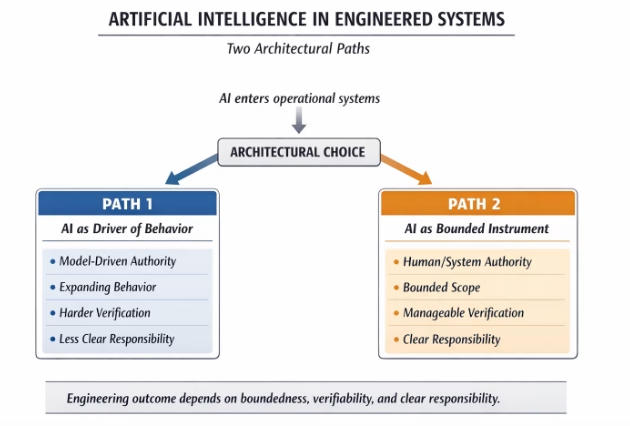
Figure 1. Two architectural paths for Artificial Intelligence in engineered systems: AI as the driver of system behavior, or AI as a bounded engineering instrument.
Path One: AI as the Driver of System Behavior
In the first path, Artificial Intelligence becomes the main source of decisions, responses, or outcomes within the system. It does more than support operation. It helps govern it.
As this happens, the behavioral domain often expands beyond tightly defined logic. Decision paths become more probabilistic, more adaptive, and less transparent. Over time, effective authority shifts toward the model.
This architecture may deliver impressive capability. However, it also creates serious engineering problems. Verification becomes harder because engineers may no longer be able to fully enumerate system behavior within a stable logic structure. Responsibility also becomes less clear because inference, not explicitly bounded rules, drives more of the outcome.
So the main issue is not randomness. The deeper issue is loss of containment. When the operating logic becomes less finite, less transparent, and less bounded, the system becomes harder to govern as an engineered system.
Path Two: Artificial Intelligence as a Bounded Engineering Instrument
In the second path, Artificial Intelligence works inside a clearly defined system boundary. It supports a larger design that keeps authority, limits, and validation logic explicit.
In this role, AI can help with diagnostics, classification, simulation, pattern detection, and design support. However, it does not take open-ended control of the system. Human judgment or deterministic system logic still holds visible authority.
As a result, the operational scope stays narrower and easier to define. The behavioral envelope remains more explicit. Engineers can still set limits, assign authority, and evaluate performance within a controlled framework.
This path still delivers real value. Artificial Intelligence can improve productivity, speed analysis, and strengthen decision support. But it does so without removing the structural conditions that make engineering possible.
That is the key advantage. AI remains useful, but it stays bounded. Because of that, verification may still be difficult, but it remains manageable within an engineering architecture.
Why the Distinction Matters
The importance of this distinction is not rhetorical. It is architectural. Systems that interact with the physical world must ultimately answer to requirements of safety, reliability, operational predictability, and accountability. Those requirements depend on bounded behavior and clear authority structures.
If the system cannot explain, constrain, or verify how critical behavior is determined, then engineering confidence weakens regardless of computational sophistication. This does not mean that every system must be simplistic or fully deterministic in the narrowest sense. It means that the architecture must preserve enough structure for the system to remain governable.
Without that structure, the system may still function, and may even perform impressively, but it begins to drift away from engineering discipline toward managed uncertainty.
The Real Purpose of This Article
This is why the first article in this series must be a definition paper. The central issue is not whether artificial intelligence is useful. It obviously is. Nor is the issue whether AI should be prohibited from entering complex systems. That is not the serious question.
The real issue is how the technology is positioned within the architecture of the system. Is it being used as a computational capability that strengthens engineering work inside explicit boundaries? Or is it being elevated into a role where it effectively determines behavior without commensurate clarity of authority, boundedness, and verifiability?
That distinction determines the character of the resulting system
Practical Questions for Engineers on Artificial Intelligence
From an engineering standpoint, several practical questions follow immediately.
What is the behavioral boundary of the AI component? Which parts of the system remain deterministic by design? Who retains final decision authority when AI outputs influence action? What assumptions define the operating envelope? How will the system be verified over time as data, software, and operating conditions evolve?
Hence, these are not peripheral implementation details. They are architectural questions. And once AI enters operational systems, they become central questions. A technically impressive model cannot answer them by itself. Only a disciplined system architecture can.
The Direction of the Series
Therefore, this framing also clarifies the broader direction of the series. The present article establishes the landscape and introduces the architectural distinction. The next articles then follow the logic already implied by that distinction: bounded behavioral domains, decision authority, verification challenges, and the continuing necessity of engineering judgment.
In that sense, the argument develops progressively from context to architecture, from architecture to responsibility, and from responsibility back to engineering practice. The purpose is not to oppose artificial intelligence, nor to celebrate it uncritically, but to evaluate it as engineers must evaluate any system element that influences real-world behavior: by its role, its limits, its authority, and its verifiability.
Conclusion: Artificial Intelligence as an Engineering Instrument
Artificial intelligence is not a single engineering destiny. It is a design choice that can be embodied in more than one architectural form.
One path places AI in the position of behavioral driver, with all the accompanying challenges of probabilistic authority, unclear responsibility, and weakened verification completeness. The other places AI within a bounded role inside a defined system architecture, where its benefits can be used without dissolving the basic conditions of engineering control.
Finally, that is the distinction that matters, and it is the distinction on which responsible integration must begin.
In conclusion, The integration of Artificial Intelligence into complex systems ultimately becomes an architectural question: whether the system remains bounded, verifiable, and governed by clear responsibility.
References
Verification in Software-Defined Vehicles: Autonomy Does Not Scale
The official NIST framework page for trustworthy AI risk management and links to the framework resources.:
Copyright Notice
© 2026 George D. Allen.
All rights reserved. No portion of this publication may be reproduced, distributed, or transmitted in any form or by any means without prior written permission from the author.
For editorial use or citation requests, please contact the author directly.
About George D. Allen Consulting:
George D. Allen Consulting is a pioneering force in driving engineering excellence and innovation within the automotive industry. Led by George D. Allen, a seasoned engineering specialist with an illustrious background in occupant safety and systems development, the company is committed to revolutionizing engineering practices for businesses on the cusp of automotive technology. With a proven track record, tailored solutions, and an unwavering commitment to staying ahead of industry trends, George D. Allen Consulting partners with organizations to create a safer, smarter, and more innovative future. For more information, visit www.GeorgeDAllen.com.
Contact:
Website: www.GeorgeDAllen.com
Email: inquiry@GeorgeDAllen.com
Phone: 248-509-4188
Unlock your engineering potential today. Connect with us for a consultation.