
Artificial Intelligence Verification Challenges in Systems

Artificial Intelligence Verification Challenges in Systems
From Responsibility to Verification
In the first three articles of this series, I argued that Artificial Intelligence enters engineered systems through distinct architectural paths, that engineering requires finite behavioral boundaries, and that responsibility must remain traceable to decision authority. The next issue follows directly from those foundations: how can engineers verify a system whose behavior is influenced by probabilistic inference?
That question is central because verification has always served as one of the main disciplines that separates engineering from aspiration. Engineers do not only define what a system is intended to do. They must also show, with defensible evidence, that the system behaves acceptably within its intended domain. In traditional engineering, that work depends on defined behavior, testable requirements, and evidence tied to clear operating conditions.
Once Artificial Intelligence begins to influence system behavior through inference rather than fixed logic alone, each of those elements becomes harder to preserve. Expected behavior may become less transparent. Requirement coverage may become harder to interpret. Evidence may become broader in volume while weaker in explanatory power. That does not make verification impossible. However, it does mean traditional models can no longer be applied without modification.
In other words, the verification challenge in AI-integrated systems is not simply that the systems are more advanced. It is that probabilistic influence changes the relationship between behavior, evidence, and confidence. That is why Artificial Intelligence verification challenges must be treated as an architectural engineering problem, not merely as a testing problem.
Deterministic Logic and Probabilistic Inference Do Not Create the Same Burden
Traditional verification models developed around systems whose logic was largely deterministic. Engineers could define the input conditions, predict the output behavior, test the response, and judge compliance against a stated requirement. Even in complex systems, that basic relationship remained visible enough to support traceability from requirement to function, from function to test case, and from test case to demonstrated evidence.
That kind of structure does not eliminate engineering difficulty, but it does create a clearer verification path. When behavior follows defined logic, engineers can usually explain why a given response occurred, what condition triggered it, and whether the result aligns with the intended design. In other words, the verification burden stays closely tied to explicit architecture.
Artificial Intelligence changes that burden when it influences system behavior through probabilistic inference. The system may still perform well, yet the path from input to output often becomes harder to inspect, explain, and fully enumerate. A model may generate a useful outcome without providing the same degree of direct traceability that engineers expect from deterministic logic. As a result, engineers must verify more than performance alone. They must also understand the assumptions that define the valid domain, the boundaries of confidence, and the conditions that cause behavior to weaken or fail.
This distinction matters because strong output is not the same as strong assurance. A deterministic function can often be challenged directly against its logic. A probabilistic function usually requires a broader argument built around bounded use, scenario coverage, uncertainty handling, and architectural containment. Therefore, deterministic logic and probabilistic inference do not create the same Artificial Intelligence verification challenge. One gives engineers more direct traceability from requirement to response. The other demands stronger external architectural control in order to preserve meaningful assurance.
Testing Completeness Becomes Harder to Defend
Verification has never required engineers to test every real-world variation. Instead, it requires them to define the relevant cases strongly enough to argue meaningful completeness within the intended scope. That has always been the real standard. Engineers do not need infinite coverage, but they do need a defensible basis for claiming that the cases most relevant to function, safety, and performance have been identified and evaluated.
In Artificial Intelligence-integrated systems, that argument becomes more difficult. Real environments contain ambiguous states, degraded inputs, conflicting signals, rare combinations, and context shifts that may appear infrequently in development data yet still matter in deployment. A perception function may work well in common conditions while weakening at the boundary between two classifications. A diagnostic model may look strong in clean data yet become less reliable when signals degrade or interact unexpectedly. These are not statistical inconveniences. They are verification problems.
This is the central difficulty: testing volume is not the same as verification completeness. A very large test set does not solve the problem by itself, because size alone cannot prove that engineers selected the right cases. They still need to know whether they identified the relevant scenarios, stressed the boundary conditions, and examined degraded or contradictory states with enough rigor to support trust.
Without that discipline, testing can expand in size while shrinking in explanatory value. Teams may generate more data, more runs, and more aggregate performance results, yet still struggle to explain whether the evidence actually covers the conditions that matter most. That is why Artificial Intelligence verification challenges are not solved by scale alone. They require structured scenario reasoning, bounded operating assumptions, and a clear argument for why the tested cases represent the intended domain.
Aggregate Performance Does Not Replace Verification Logic
This is where verification can easily become overstated.
Accuracy metrics, benchmark scores, and large simulation counts often create a sense of confidence. On the surface, those numbers can look persuasive because they suggest scale, consistency, and technical maturity. However, they do not automatically show that the system is well understood under the conditions that matter most. A model may perform impressively in aggregate while remaining weak in exactly those situations that threaten safety, authority, or functional continuity.
That is the underlying problem with aggregate performance. It summarizes results, but it does not necessarily explain them. A high score may hide the fact that the system struggles near classification boundaries, under degraded sensor conditions, during conflicting inputs, or in rare combinations that carry disproportionate engineering importance. In those cases, the average result can sound stronger than the actual verification basis.
Therefore, engineers need more than evidence that the model often works. They need evidence that the system remains bounded, that the critical cases were deliberately identified, and that the architecture contains uncertainty when conditions move outside the intended basis of trust. They also need to know what performance means in context: what conditions produced it, what assumptions shaped it, and where its limits begin to appear.
That is why Artificial Intelligence verification cannot rely on performance reporting alone. Strong metrics may support the case, but they cannot replace the logic of verification. This article therefore does not argue against Artificial Intelligence. Instead, it argues that probabilistic systems need stronger verification structure, not weaker expectations.
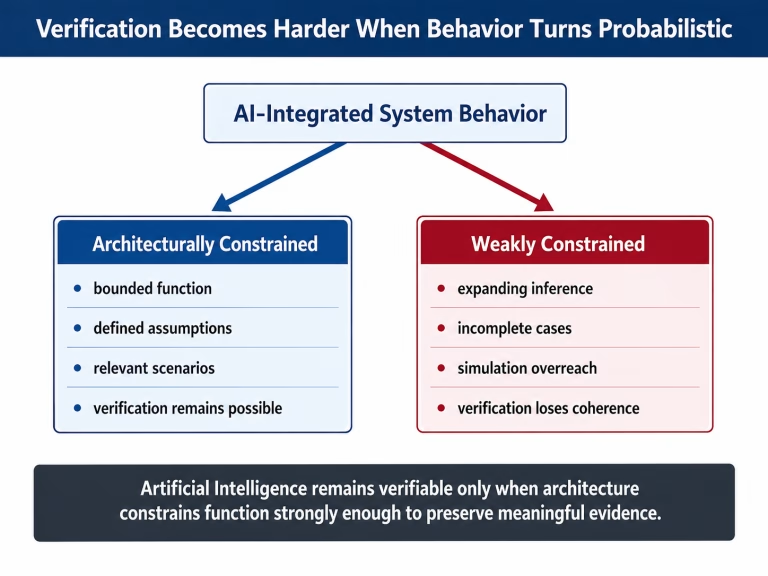
Figure 1. Verification in AI-integrated systems depends on architectural constraints: bounded functions and defined assumptions preserve meaningful evidence, while weakly constrained inference weakens verification coherence.
Simulation Helps, but It Does Not Solve the Problem Automatically
Simulation remains indispensable in modern engineering. Real-world testing alone cannot cover enough operating conditions, edge cases, timing interactions, or lifecycle cost constraints to support a serious validation effort. Engineers need simulation because it extends reach, reduces cost, and allows them to explore conditions that would be difficult, unsafe, or impractical to reproduce repeatedly in physical testing.
However, simulation does not solve the verification problem automatically, especially in Artificial Intelligence-integrated systems. A simulation environment is only as useful as its fidelity, assumptions, calibration, and scenario relevance. It may provide large amounts of evidence, but the value of that evidence still depends on how well the simulated world represents the conditions that actually govern system behavior.
That is why engineers cannot treat simulation as a substitute for bounded engineering reasoning. Generally, if the model of the world is too clean, the validation case becomes optimistic. Then, if the scenario library is too narrow, simulation volume becomes less meaningful. Finally, if the sensor behavior is idealized, then the model may look more robust than it will in deployment. And if the simulation basis drifts away from operational reality over time, verification evidence can age without anyone noticing.
In that sense, simulation is not a shortcut around Artificial Intelligence verification challenges. It is a tool that depends on disciplined use. It can strengthen verification when engineers define its limits clearly, calibrate it carefully, and tie it to the real operating domain. Without that discipline, simulation can produce impressive quantities of evidence while weakening confidence in what that evidence actually proves.
Lifecycle Verification Drift Is a Core Engineering Problem
Verification is never only a launch activity. Artificial Intelligence makes that harder to ignore.
In traditional systems, engineers already understood that released products could drift away from their original assumptions through wear, updates, integration changes, or new operating conditions. However, AI-integrated systems often make that drift less visible and harder to interpret. The system may continue to function, yet the basis on which engineers originally justified trust can weaken over time.
Several forces can drive that change. Data distributions shift. Sensor behavior changes. Interfaces evolve. Software revisions alter interaction effects. Operating contexts expand quietly beyond original assumptions. A function that once operated inside a well-understood domain may gradually encounter conditions that the original verification basis did not fully represent. Even when the initial validation effort was serious, the relationship between the validated object and the deployed object can weaken over time.
That is lifecycle verification drift.
It does not always appear as an immediate failure. More often, it appears first as narrower validity, weaker confidence, or growing dependence on assumptions that no longer match the real operating environment. A model may still perform well in many cases while becoming less reliable near boundaries, under degraded conditions, or after changes elsewhere in the system. Because that decline can be uneven and gradual, organizations may miss it if they rely too heavily on old evidence or high-level performance summaries.
Engineers cannot treat that as a minor maintenance issue. They must treat it as a verification problem tied directly to scope, evidence, and responsibility across the lifecycle. That is why Artificial Intelligence verification cannot end at release. It requires explicit revalidation triggers, ongoing attention to assumptions, and disciplined judgment about when the original basis of trust no longer fully applies.
Architectural Constraints Keep Verification Meaningful
This leads to the central thesis of Article 4: Artificial Intelligence systems require architectural constraints to remain verifiable.
Engineers cannot solve the verification problem by asking the model to become more impressive. Higher performance, larger data sets, and broader testing activity may improve parts of the system, but they do not by themselves create a defensible verification basis. Engineers preserve meaningful assurance only when they constrain the function strongly enough that they can still generate, interpret, and defend evidence within a defined scope.
That is why architectural discipline matters so much. A verifiable Artificial Intelligence function needs bounded use cases, defined operational envelopes, explicit authority boundaries, scenario libraries tied to system intent, degraded-state logic, revalidation triggers, and traceable assumptions across the lifecycle. Each of these elements narrows uncertainty and strengthens the connection between claimed behavior and supporting evidence. Without them, the system may still produce useful outputs, but verification loses coherence because the function itself is no longer sufficiently contained.
These are not administrative layers wrapped around an autonomous technical core. They are the conditions that keep verification attached to engineering reality. They define what the system is supposed to do, under which conditions it is trusted to do it, and how engineers will recognize when that trust must be narrowed, challenged, or renewed.
That is the real role of architecture in Artificial Intelligence verification. It does not slow innovation. It makes assurance possible.
Conclusion: Artificial Intelligence
Artificial Intelligence does not make verification obsolete. Instead, it makes verification more demanding. Once system behavior depends in part on probabilistic inference, engineers can no longer rely on traditional verification habits alone. They must defend completeness more carefully, challenge simulation assumptions more directly, and govern lifecycle drift more deliberately. In other words, the burden of verification does not disappear. It becomes harder to define, harder to maintain, and easier to overstate if the surrounding architecture is weak.
For that reason, the central issue is not whether AI can produce strong outputs. The central issue is whether the surrounding architecture constrains Artificial Intelligence strongly enough to keep verification meaningful. If engineers preserve bounded functions, explicit assumptions, relevant scenario libraries, and governed revalidation over time, then Artificial Intelligence can remain inside a defensible engineering structure. However, if probabilistic influence expands faster than architectural control, verification loses coherence. Testing may continue, simulation may expand, and performance may still look impressive, yet the basis for trust becomes harder to explain and defend.
That is the real dividing line. Verification remains possible when engineers keep the function bounded strongly enough that evidence still means something. Without that discipline, Artificial Intelligence verification begins to drift away from engineering assurance and toward managed uncertainty.
References
Article 3: Artificial Intelligence and the Missing Architecture of Responsibility:
The official NIST framework page for trustworthy AI risk management and links to the framework resources.:
Copyright Notice
© 2026 George D. Allen.
All rights reserved. No portion of this publication may be reproduced, distributed, or transmitted in any form or by any means without prior written permission from the author.
For editorial use or citation requests, please contact the author directly.
About George D. Allen Consulting:
George D. Allen Consulting is a pioneering force in driving engineering excellence and innovation within the automotive industry. Led by George D. Allen, a seasoned engineering specialist with an illustrious background in occupant safety and systems development, the company is committed to revolutionizing engineering practices for businesses on the cusp of automotive technology. With a proven track record, tailored solutions, and an unwavering commitment to staying ahead of industry trends, George D. Allen Consulting partners with organizations to create a safer, smarter, and more innovative future. For more information, visit www.GeorgeDAllen.com.
Contact:
Website: www.GeorgeDAllen.com
Email: inquiry@GeorgeDAllen.com
Phone: 248-509-4188
Unlock your engineering potential today. Connect with us for a consultation.