New Optimization: Improving the Output Results

New Optimization: Improving the Existing System
Introduction: Why Optimization Matters
Initially, Systems rarely begin in their final form. Obviously, they evolve, adding functions, requirements, and technologies along the way. Moreover, once a system matures, removing elements is not always possible. At that point, the discipline of Optimization becomes essential.
Generally, optimization process refines what already exists. Where Complexity Reduction eliminates unnecessary parts or interfaces, Optimization accepts the structure and works to improve performance, cost, or reliability. The system may remain complex, but it operates more efficiently.
Philosophically, Optimization treats complexity as a constraint rather than a choice. Instead of asking what can be removed, Optimization asks how can this be improved. This focus allows engineers to extract more value without restructuring the entire system.
Hence, in automotive engineering, Optimization is everywhere. Engines are tuned for better fuel economy. Inverters are calibrated for higher efficiency. Software is updated to run faster or consume less memory. Even validation benefits from automation and smarter coverage metrics. Each action accepts complexity but ensures it operates at its best.
Optimization matters because systems cannot be redesigned from scratch each time. Vehicle programs, supplier contracts, and regulatory frameworks often lock in structures. In those cases, Optimization is not just helpful—it is the only path forward.
Optimization vs. Complexity Reduction
Complexity Reduction and Optimization are complementary but distinct. Initially, both aim to improve systems, yet they approach the challenge from opposite directions.
Complexity Reduction removes elements to simplify the structure. Therefore, it eliminates unnecessary parts, redundant functions, or excessive interfaces. Moreover, reduction asks: Does this element truly need to exist?
By contrast, Optimization, refines what remains. Sequentially, it sharpens tolerances, tunes parameters, and improves efficiency. Furthermore, optimization asks: How can this element work more effectively? Importantly, Optimization requires an initial design. Some project plans mistakenly schedule optimization before a design proposal exists, but without a baseline, refinement has no reference point. Therefore, the purpose of Optimization is to improve outputs from a given design—performance, material flow, operational cost, or reliability.
Consequently, both concepts demand structured projects. Essentially, they are most effective during a change of state in production, such as a model-year changeover, when systems are already being revised.
Furthermore, a simple example clarifies the difference. A platform may contain three separate ECUs: one for infotainment, one for navigation, and one for driver information. Complexity Reduction consolidates them into a single domain controller, removing interfaces. Optimization improves the software on each ECU, reducing power use and streamlining updates.
Visual Aid – Optimization vs. Complexity Reduction
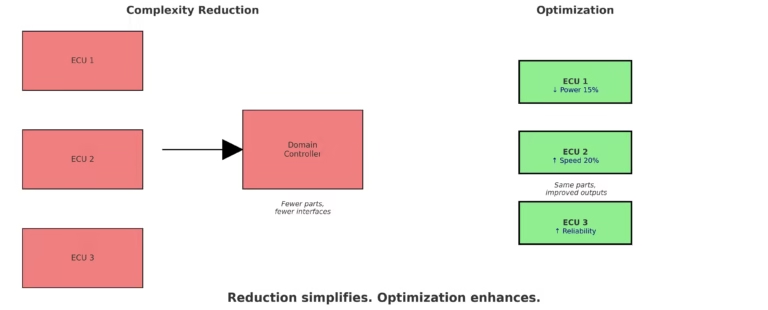
Together, they form a balanced strategy: Reduction removes weight, Optimization enhances what remains.
This diagram highlights the difference between Complexity Reduction and Optimization. On the left, three separate ECUs are consolidated into a single domain controller, removing interfaces and simplifying the architecture—fewer parts, fewer interfaces. On the right, the same three ECUs remain, but each is enhanced: power use drops, speed improves, and reliability increases—same parts, improved outputs. Together, the concepts show that Reduction simplifies while Optimization enhances, and both are necessary to sustain complex systems.
Methods of Optimization
Initially, with a design in place, engineers can practice Optimization. Without an initial design, refinement has no foundation. Hence, optimization improves outputs of the design—performance, material flow, cost, or durability—through structured methods that require engineering discipline.
Process optimization. Generally, manufacturing steps are refined to reduce waste and improve throughput. Lean and Six Sigma tools guide adjustments. For example, a stamping line may be rebalanced to cut idle time.
Design optimization. During in-process developments, Engineers adjust geometry, tolerances, or materials without altering the overall architecture. An aluminum suspension arm, for instance, can be re-optimized to lower weight while maintaining strength.
Performance optimization. Systems are calibrated for efficiency. Engines are tuned for economy, inverters for lower thermal losses, or infotainment for faster response. Therefore, each refinement delivers more from existing parts.
Verification optimization. Testing itself benefits from optimization. Automated regression, smarter coverage metrics, and simulation tools reduce cost and time. Therefore, Validation becomes leaner without reducing requirements.
Software optimization. Code restructuring reduces memory demand or speeds execution. Updates often yield improvements without hardware changes.
In every case, Optimization accepts complexity but ensures it operates at its best. Like Reduction, it is most practical during production changeovers, when resources are available and updates can be implemented without destabilizing current output.
Quantifying Optimization
For Optimization to be meaningful, engineers must measure its effects. Without metrics, improvements remain subjective and difficult to defend. Numbers transform refinement into evidence.
First, performance indices. Gains in efficiency, speed, or output must be expressed in measurable terms. A powertrain calibration that increases fuel economy by three percent, or an inverter redesign that lowers thermal losses by five percent, demonstrates real impact.
Second, cost savings. Optimization often reduces material use, cycle time, or energy consumption. Each improvement should translate into cost per part or cost per vehicle, showing executives and suppliers the tangible value of refinements.
Third, defect reduction. By tightening tolerances or improving process control, Optimization lowers defect rates. This improvement connects directly to warranty claims and customer satisfaction.
Fourth, trade-offs. Not all optimizations improve every dimension. Reducing weight may raise cost; lowering cycle time may increase scrap rates. Quantification allows teams to balance trade-offs explicitly instead of relying on intuition.
An example from electric vehicles illustrates the point. Optimizing an inverter for better thermal performance may require new materials. Engineers must weigh the higher part cost against gains in efficiency and reduced cooling demands. Only quantified trade-offs make that decision clear.
Finally, metrics build credibility. Suppliers, executives, and regulators respond to numbers, not intentions. Quantification ensures Optimization is treated as a discipline, not as tinkering. By tracking performance, cost, defects, and trade-offs, teams prove that their efforts move the system forward.
Engineering Practices for Optimization
Naturally, Optimization is not a one-time adjustment. Therefore, it requires discipline, methods, and supporting culture. Consequently, without structured practices, improvements remain isolated and unsustainable.
First, continuous improvement. Cultures built on Kaizen or Lean encourage small, steady refinements. Engineers learn to question existing processes and propose adjustments that increase efficiency or reliability. These habits accumulate into significant gains over time.
Second, advanced simulation. Modern tools allow engineers to run thousands of scenarios before physical trials. Sensitivity analysis identifies which parameters matter most, directing resources to the variables that drive performance. Simulation shortens development cycles and lowers cost while increasing accuracy.
Third, data-driven testing. Automated test benches and analytics extract more value from each validation run. Rather than repeating static tests, engineers apply coverage metrics to ensure each condition adds unique insight. The result is higher confidence with fewer tests.
Fourth, supplier collaboration. Many optimizations require close work with suppliers who control materials, tolerances, or processes. Structured partnerships allow both sides to refine components in ways that benefit the entire system, not just one node in the chain.
Finally, structured change management. Optimization projects must be scoped, approved, and executed like any other engineering activity. Without formal project status, refinements risk being overlooked, delayed, or reversed. Linking Optimization to change-of-state events such as model-year transitions ensures improvements enter production smoothly.
These practices anchor Optimization as a repeatable discipline. By combining cultural habits, analytical tools, and structured project management, engineers ensure refinements deliver measurable and lasting value.
Automotive Examples of Optimization
Overall, examples from the automotive industry show how Optimization improves systems without altering their fundamental structure. These cases highlight refinements that increase performance, reduce cost, and improve customer experience while accepting the system’s inherent complexity.
Powertrain calibration. Internal combustion engines cannot shed all their parts, but engineers continually optimize air–fuel ratios, ignition timing, and transmission maps. Small gains—two or three percent in efficiency—compound across millions of vehicles, reducing both fuel cost and emissions.
EV battery optimization. Battery packs remain complex assemblies, but algorithms optimize how cells balance charge and discharge. Improved thermal management strategies refine cooling efficiency, increasing pack life without redesigning the module structure.
Software optimization. Infotainment systems often run on fixed hardware. Updates streamline boot times, reduce memory demand, and enhance responsiveness. Customers notice better performance, yet the hardware remains untouched.
Manufacturing optimization. Welding, painting, and stamping lines rarely change wholesale. Instead, process parameters are adjusted to reduce rework and minimize scrap. For example, optimizing paint booth airflow can cut defects while saving energy.
Inverter refinement. In electric drivetrains, inverters convert DC to AC power. By optimizing switching frequencies and cooling flow, engineers achieve measurable efficiency gains without altering the inverter’s role or basic design.
Therefore, each example shows that Optimization does not challenge the system’s existence. Moreover, it works within the given design, refining outputs—performance, cost, reliability, or sustainability. Hence, in combination with Complexity Reduction, Optimization ensures systems not only survive but excel within their constraints.
Organizational Optimization
Essentially, complexity does not reside only in technical systems. Furthermore, organizations themselves can be refined through Optimization. Unlike Complexity Reduction, which removes layers or processes, Organizational Optimization improves the effectiveness of what remains.
First, streamline workflows. Many engineering groups already have established processes. Optimization refines these by cutting delays, balancing workloads, and improving information flow. For example, adjusting review cycles to match program milestones reduces waiting time without removing necessary oversight.
Second, enhance decision-making. Large organizations often suffer from slow approvals. Optimization focuses on improving speed and clarity, such as setting escalation paths or standardizing approval criteria. Decisions move faster not because steps vanish, but because they occur more efficiently.
Third, refine resource allocation. Teams often have the right resources, but they are not always deployed effectively. Optimization adjusts staffing, tooling, or lab time to align with the program’s most critical needs. This ensures projects progress without bottlenecks.
Fourth, supplier engagement. OEMs cannot always reduce the number of suppliers, but they can optimize collaboration. Structured communication, aligned testing protocols, and shared metrics reduce misunderstandings and improve efficiency across the chain.
Finally, apply data-driven metrics. Organizations measure productivity, defect rates, and timing. Optimization uses these metrics to highlight where processes can be tightened without removing them. The result is not fewer processes but better ones.
Consequently, organizational optimization processes demonstrate that refinement is as important in management as it is in design. By tuning workflows, decisions, and resources, companies extract more value from existing structures while maintaining stability.
Conclusion: Refinement as Discipline
In conclusion, Optimization is the discipline of refinement. It does not challenge whether a system should exist, as Complexity Reduction does. Instead, it asks how the existing structure can deliver more—greater performance, lower cost, higher reliability, or smoother operation.
Throughout this chapter, we explored Optimization as a concept distinct from Reduction. Furthermore, reduction eliminates unnecessary elements; Optimization sharpens those that remain. Finally, one questions the architecture, the other improves its execution. Together, they form complementary approaches. Without Reduction, systems collapse under unnecessary weight. Without Optimization, systems stagnate, unable to meet rising demands.
Additionally, methods of Optimization—process, design, performance, verification, and software—illustrate how refinements work in practice. Quantification provides proof: metrics such as efficiency gains, defect rate reductions, or cost savings show that optimization is not tinkering but disciplined improvement. Automotive examples confirm the reality: engines tuned for fuel economy, inverters calibrated for efficiency, software streamlined for responsiveness, and manufacturing processes adjusted for lower scrap.
Converseley, organizations also benefit. Streamlined workflows, faster decision-making, and better resource allocation show that optimization applies beyond technical systems. It strengthens how people and processes operate, ensuring programs move forward without unnecessary delays.
Ultimately, Optimization ensures that existing systems do not merely function but excel. It is the act of extracting the most value from what already exists.
Consequently, the next article turns to Requirements: The First Line of Defense, exploring how clear requirements form the foundation for both Complexity Reduction and Optimization.
References
-
INCOSE Systems Engineering Handbook – Overview of systems engineering principles, including V-Model context
www.incose.org/products-and-publications/se-handbook -
ISO/IEC/IEEE 15288: System Life Cycle Processes – International standard defining system development and verification processes
www.iso.org/standard/63711.html - 3. ISO 26262: Road Vehicles – Functional Safety – Automotive functional safety standard where the V-Model is often applied
www.iso.org/standard/43464.html
References to Complexity in Systems Engineering Series:
- What Do We Mean by Complexity?
- The Growth of Complexity
- Counting Complexity – Why Interfaces Grow Faster Than Parts
- Propagation: How Complexity Spreads
- Complexity Reduction: The Discipline of Simplification
- Optimization: Improving the Existing System <—You are here
- Requirements: The First Line of Defense
- Measuring and Managing Complexity
- From ppm to ppb – The Statistical Reality of Vehicle Defects
- Complexity in Practice: Case Studies & Critiques
Simulation and Virtual Models – Managing Complexity in Verification and Validation
Systems Engineering References
About George D. Allen Consulting:
George D. Allen Consulting is a pioneering force in driving engineering excellence and innovation within the automotive industry. Led by George D. Allen, a seasoned engineering specialist with an illustrious background in occupant safety and systems development, the company is committed to revolutionizing engineering practices for businesses on the cusp of automotive technology. With a proven track record, tailored solutions, and an unwavering commitment to staying ahead of industry trends, George D. Allen Consulting partners with organizations to create a safer, smarter, and more innovative future. For more information, visit www.GeorgeDAllen.com.
Contact:
Website: www.GeorgeDAllen.com
Email: inquiry@GeorgeDAllen.com
Phone: 248-509-4188
Unlock your engineering potential today. Connect with us for a consultation.