
Crafting CRS Sensing Logic: New Passive Safety Tech

Crafting Child Restraint Seat (CRS) Sensing Logic
Enhancing Child Safety: Understanding CRS Detection and Classification
The primary focus of this article is to delve into the essential Occupant Sensing capabilities, particularly concerning the detection of occupant safety devices like Child Restraint Systems (CRS) and other relevant assemblies, including those for individuals with disabilities. Consequently, our discussion will explore the fundamental definition and development of the basic comprehension logic (algorithm) pertaining to non-living functional objects utilized in vehicles to restrain occupants.
Furthermore, as data acquisition occurs within the Field of View, incoming objects are initially categorized as Non-living Objects. Subsequently, upon installation, they must be identified as CRS (Child Restraint System). Sequentially and logically, classification follows. Moreover, if dictated by the governing features, there exists the potential to develop functional recognition of a “Properly Installed and Belted” CRS.
Finally, let’s examine the systems approach necessary to address this topic from a Passive Safety standpoint.
The Significance of CRS Detection and Classification Capabilities
Generally, the overall objective behind developing any functional capability is to ensure Occupant Safety throughout vehicle utilization, regardless of the occupant or driving conditions. Consequently, this includes the transportation of infants, children and individuals with disabilities, equipped with appropriate safety devices.
Hence, upon the arrival of any occupant, the system’s functional requirements are to detect, locate and classify the earliest feasible moment in the logical sequence:
- Detecting and determining presence and approximate Location
- Verifying the Location and approximating the size of the occupant
- Approximating the usage of the Seat Belt and Classifying the seated person
- Finally, verifying the seated and classified body size in the given seat
Consequently, a similar approach is adopted for Restraint devices brought into the vehicle interior. This logic enables the System to promptly detect and classify the status of incoming children or individuals with disabilities utilizing the safety devices.
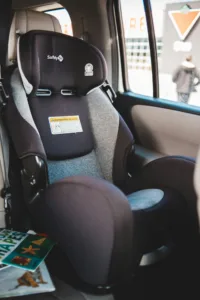
Conveniently, for the sake of simplicity in this article, Child Restraint System (CRS) assemblies are categorized into three types:
- Rearward-facing CRS
- Forward-facing CRS
- Booster seat
Furthermore, these classifications typically consider the child’s age, height, and weight, although other configurations are feasible. Additionally, regarding handicap devices, numerous possibilities exist, which can be addressed as needed.
Development of the Algorithm: Systems Engineering Approach
The Systems Engineering Method is based on developing a functional working model, where high-level requirements roll down to execution elements (subsystems), streamlining Data Acquisition and processing for analysis and decision-making (Reference below).
Consequently, given the nature of Child Restraint System (CRS) geometry and functionality, an effective approach begins with understanding the “Initial Condition,” which entails comprehending the Interior surfaces, particularly the A-Side of the seats. Initially, this involves integrating them into the original scan and calibration by the sensor(s) utilized by the System.
Furthermore, upon the processor registering “Empty” seats, they transition to “Empty/Non-Occupied,” crucial for the algorithm tracking Occupant Presence Location. Subsequently, as the CRS is placed and Data Acquisition continues, specific elements of the new object must be identified to designate it as “CRS Present.” Although the specifics of the “Data Set” requirements are TBD, depending on system capability and time elapsed, higher reliability determination is feasible before vehicle readiness to drive.
Moreover, each defined classification necessitates a specific dataset “standard” to qualify collected data accordingly.
Continuing with the verification algorithm, considering physical CRS points, aligning with Seat geometry, and Seat Belt engagement, achieving the “Properly Installed and Belted” CRS classified status is attainable by the System’s algorithm (Signal Output in ECU), relayed to the On-board ECU interface. (See the Seat Belt Routing reference.)
Advancing Vehicle Safety with AI: Exploring CRS Utilization for Passive Safety
Addressing the utilization of AI tools for this function, the potential application of AI in recognizing items brought into the vehicle proves highly beneficial for developing the Data Acquisition algorithm, offering a streamlined strategy. Initially, focusing on static Use cases enables sequential data processing combined with Machine learning until the dataset criteria are met for specific configurations of CRS types within the Field of View.
Moreover, aligning this comprehensive development with Simulation technology, particularly Virtualization sets, aids in crafting safe, high-quality products while facilitating simulation and verification of intended performance. Therefore, the integration of AI tools presents an excellent opportunity to refine preliminary necessities and execute executive algorithms efficiently. Embracing AI in this manner enhances the efficacy and precision of CRS Classification, driving advancements in vehicle safety and functionality.
References:
Virtual Development: https://georgedallen.com/virtual-development-embracing-tomorrow-today/
“Virtualization” definition: https://en.wikipedia.org/wiki/Virtualization
Review of the Applicable Usecases
An overview of Usecases utilizing various types of Child Restraint Systems demonstrates the successful and safe placement of children in them. Consequently, executive subsystems can effectively assess and verify first that CRS elements and the vehicle are properly assembled, and second with the utilization of the CRS means secure the occupant in it. This approach remains valid across all possible sizes of children placed in CRS.
Additionally, in cases where a small occupant is directly placed onto the seat, it should be treated same as an adult occupant. Consequently, the Signal Outputs library will be comprehensive, encompassing all applicable resultant cases. Moreover, cases where requirements for the “properly belted” occupant (data sets) are unsatisfied and the total condition score is unmet, indicating the occupant may not be belted or the CRS may not be properly set and belted, must be included in Signal Outputs designation for the System to provide information to the On-board ECU.
Conclusion: Achieving Optimal CRS Utilization by the Passive Safety Features
In conclusion, the overall system’s capability to recognize the proper type of CRS and assess its correct placement and utilization is an integral aspect of Occupant Sensing System development. Typically, each specific Restraint Classification standard must be addressed through a dedicated development project to align the algorithm with decision-making criteria.
Ultimately, the system’s ability to facilitate and utilize these functions marks a significant step towards comprehensive evolution in achieving Passive Safety goals.
References
- Reference to Systems Engineering Method: https://georgedallen.com/systems-v-model-strategy-in-automotive-design/
- System Prerequisites https://georgedallen.com/usecases-development-of-the-prerequisites-new-databases/
- Passive Safety Features: https://georgedallen.com/evolution-of-occupant-safety-systems-in-the-vehicle-development/
- Governing Features https://georgedallen.com/development-of-the-prerequisites-new-passive-safety-features/
- Occupant Presence Detection https://georgedallen.com/develop-presence-detection-new-occupant-sensing-tech/
- Occupant Location https://georgedallen.com/develop-occupant-location-new-sensing-tech/
- Basic Classification https://georgedallen.com/develop-the-core-of-occupant-classification-new-sensing-tech/
- 1.Seat Belt Monitoring Development https://georgedallen.com/advanced-seat-belt-monitoring-technology-in-occupant-safety/
- 2. Seat Belt Monitoring Function development Part1 https://georgedallen.com/crafting-new-seat-belt-monitoring-tech-for-passive-safety/
- 3. Seat Belt Monitoring Function development Part2 https://georgedallen.com/crafting-new-seat-belt-monitoring-tech-for-passive-safety-2/
- Object Classification – https://georgedallen.com/develop-the-core-of-object-classification-new-sensing-tech/
- Classification – Stratification covered separately later
- NCAP Standard https://www.euroncap.com/en/car-safety/the-ratings-explained/safety-assist/occupant-status-monitoring/
- Seat Belt Wikipedia: https://en.wikipedia.org/wiki/Seat_belt
- Child Safety Seat: https://en.wikipedia.org/wiki/Child_safety_seat
About George D. Allen Consulting:
George D. Allen Consulting is a pioneering force in driving engineering excellence and innovation within the automotive industry. Led by George D. Allen, a seasoned engineering specialist with an illustrious background in occupant safety and systems development, the company is committed to revolutionizing engineering practices for businesses on the cusp of automotive technology. With a proven track record, tailored solutions, and an unwavering commitment to staying ahead of industry trends, George D. Allen Consulting partners with organizations to create a safer, smarter, and more innovative future. For more information, visit www.GeorgeDAllen.com.
Contact:
Website: www.GeorgeDAllen.com
Email: inquiry@GeorgeDAllen.com
Phone: 248-509-4188
Unlock your engineering potential today. Connect with us for a consultation.