
New E/E Architecture: How OEMs Organize for Advanced Sensing

Introduction: New E/E Architecture
How OEMs Organize for New E/E Architecture
Initially, the transition to centralized and zonal (Electrical/Electronic) E/E Architecture demands not only technical innovation but also a fundamental shift in organizational design. While traditional OEM structures remain rooted in domain-specific silos and component-driven development, they increasingly struggle to support the cross-functional, software-driven needs of modern vehicles. As a result, this article proposes a hypothetical OEM organizational structure that is purpose-built to deliver on the promise of scalable, modular, and software-defined vehicles.
Why Traditional OEM Structures Fall Short
Generally, legacy organizations were built around hardware domains such as infotainment, body electronics, powertrain, chassis, and ADAS. However, these silos often make it difficult to:
firstly, implement feature-driven development across domains,
secondly, define and enforce system-level requirements and interfaces,
thirdly, manage software integration across ECUs, and
fourthly, trace and update functions throughout the vehicle lifecycle.
In addition, traditional validation and release processes are not well suited for continuous development or over-the-air (OTA) updates, further limiting flexibility.
Challenges in Transitioning Traditional Organizations
Generally, while the benefits of modernization are clear, transitioning legacy organizations presents several significant challenges. First, inertia remains a major barrier, as long-standing development practices often resist change. Second, many OEMs rely heavily on Tier 1 suppliers for integrated solutions, which complicates internal control over architectural direction. Third, change management becomes a critical factor—shifting toward a cross-functional, feature-based model requires extensive retraining, governance restructuring, and cultural adaptation. Therefore, strong leadership commitment and structured transformation programs are essential to ensure successful implementation.
Principles for a Future-Ready Organizational Structure
Essentially, to align effectively with centralized E/E strategies, OEMs must reorganize around several key guiding principles. First, system ownership must shift toward end-to-end responsibility for features rather than isolated components. Second, interface governance should be formalized through a dedicated architecture and interface management office. Third, software and hardware teams must be integrated to support co-development from Day 1. Fourth, lifecycle alignment is essential—organizations must retain ownership of functionality beyond SOP, including over-the-air (OTA) updates. Finally, scalable modularity should be achieved through reuse-oriented design supported by validated software libraries.
Proposed Organizational Structure: Key Elements
Overall, to support this shift, a modern OEM organizational structure should include the following key functional groups:
1. Systems Engineering & Architecture Division
This team owns the definition of the functional architecture and the derivation of system-level requirements. It also maintains interface libraries and validation matrices, while coordinating functional allocation between the central ECU and zonal ECUs.
2. Feature Domain Teams
Organized around customer-facing functions—such as parking, cabin comfort, crash response, and connectivity—these teams take ownership of feature requirements, software modules, and validation. They work across hardware layers and with suppliers to ensure consistent implementation.
3. Platform Integration & Validation Group
Responsible for executing end-to-end system testing, this group manages release builds, simulation environments, and HIL rigs. It also oversees OTA readiness and software version control across programs.
4. Modular Software Library & Middleware Team
This team develops reusable software components and middleware frameworks. In addition, it ensures platform abstraction, version tracking, and cybersecurity compliance.
5. Program Management (Agile Vehicle Teams)
These cross-functional squads represent one or more vehicle programs and coordinate delivery and validation timelines across all domains.
6. Supplier Interface & Commodity Management
This function manages physical hardware suppliers and ensures adherence to software integration contracts and interface specifications.
Visual Aid: Hypothetical Org Chart Layout
Hypothetically, the organizational structure proposed can be visualized as follows:
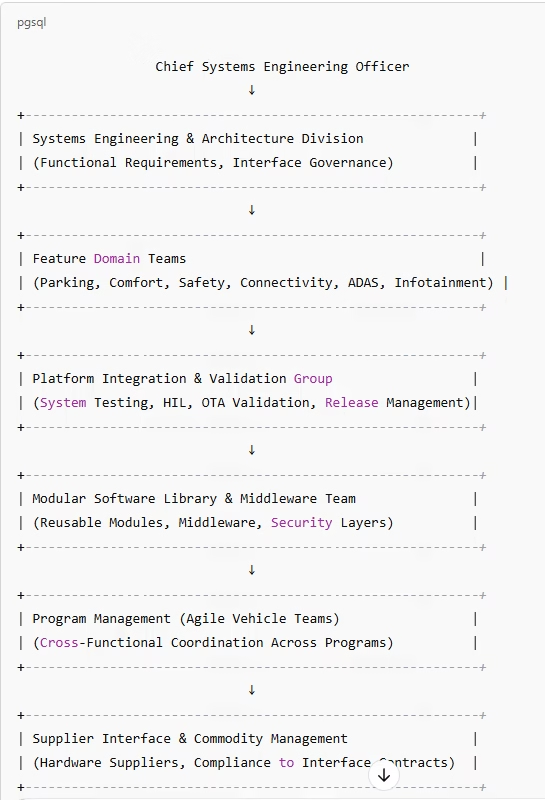
Overall, this structure highlights the vertical ownership of functional areas and the horizontal cross-domain integration critical for successful E/E Architecture execution.
Benefits of This Structure
Obviously, this organizational structure offers several important advantages. It enables faster time-to-market for new features by reducing development bottlenecks. It also facilitates easier software reuse across vehicle lines, improving efficiency and consistency. Additionally, higher integration quality leads to fewer recalls and improved customer satisfaction. The model enhances long-term support for updateability and regulatory compliance. Finally, it provides stronger internal control over functional evolution and cybersecurity, reducing reliance on external suppliers and fragmented processes.
Conclusion: E/E Architecture - Org Chart Proposed
In conclusion, a successful transformation of E/E Architecture is not purely a technical endeavor—it is equally an organizational one. Furthermore, by adopting a cross-functional, feature-centric structure anchored in strong systems engineering leadership, OEMs can unlock the full potential of centralized and zonal architectures.
As a result, companies that execute this transition effectively will gain an edge not only in technology leadership but also in operational efficiency and investor appeal. Ultimately, this model can serve as a reference point for rethinking organizational agility in the era of software-defined vehicles.
References
- NHTSA Recall Reports for GM:
https://static.nhtsa.gov/odi/rcl/2024/RCLRPT-24V674-9670.PDF
- Ford Recall Details (Reuters):
- Tesla Autopilot Issues (The Guardian):
https://www.theguardian.com/technology/2024/apr/26/tesla-autopilot-fatal-crash
- Tesla TPMS Recall (People.com):
- Infineon Radar Sensors Overview:
https://www.infineon.com/cms/en/product/sensor/radar-sensors/radar-sensors-for-automotive/
- NXP Automotive Radar Solutions:
- www.georgedallen.com/development-of-a-new-ai-algorithm-a-step-by-step-guide/
- www.georgedallen.com/usecases-development-of-the-prerequisites-new-databases/
- McKinsey: https://www.mckinsey.com/industries/automotive-and-assembly/our-insights/rewiring-car-electronics-and-software-architecture-for-the-roaring-2020s
- Roland Berger: www.rolandberger.com/en/Insights/Publications/Electrical-electronic-architectures-in-the-auto-industry.html
- IEEE Spectrum on Vehicle Architectures: https://spectrum.ieee.org/car-electronics-architecture
- Boston Consulting Group (BCG): https://www.bcg.com/publications/2021/automotive-electronics-and-architecture-shift
- Infineon Automotive Architecture Overview: https://www.infineon.com/cms/en/product/sensor/radar-sensors/
About George D. Allen Consulting:
George D. Allen Consulting is a pioneering force in driving engineering excellence and innovation within the automotive industry. Led by George D. Allen, a seasoned engineering specialist with an illustrious background in occupant safety and systems development, the company is committed to revolutionizing engineering practices for businesses on the cusp of automotive technology. With a proven track record, tailored solutions, and an unwavering commitment to staying ahead of industry trends, George D. Allen Consulting partners with organizations to create a safer, smarter, and more innovative future. For more information, visit www.GeorgeDAllen.com.
Contact:
Website: www.GeorgeDAllen.com
Email: inquiry@GeorgeDAllen.com
Phone: 248-509-4188
Unlock your engineering potential today. Connect with us for a consultation.