
New E/E Architecture: Transformation of Vehicle Software and Content

New E/E Architecture: Transformation of Vehicle Software and Content
Introduction: New E/E Architecture
Essentially, the automotive industry is undergoing a technological revolution. At the core of this shift is the transformation of Electrical/Electronic (E/E) Architecture. Traditionally, vehicles relied on domain-based designs; however, the transition to centralized and zonal architectures is now reshaping how vehicles are built, updated, and experienced. As a result, this evolution holds profound implications for OEM competitiveness and introduces new opportunities for strategic investors seeking to align with future-ready platforms.
Defining E/E Architecture
At its core, E/E Architecture refers to the integrated system of electronic control units (ECUs), sensors, actuators, communication networks, power distribution, and software layers within a vehicle. In essence, it defines how engineers implement features and functions, how components interact, and how software and hardware evolve throughout the vehicle’s lifecycle. Consequently, it forms the foundational framework for both vehicle functionality and adaptability.
The Evolution: Domain to Centralized to Zonal
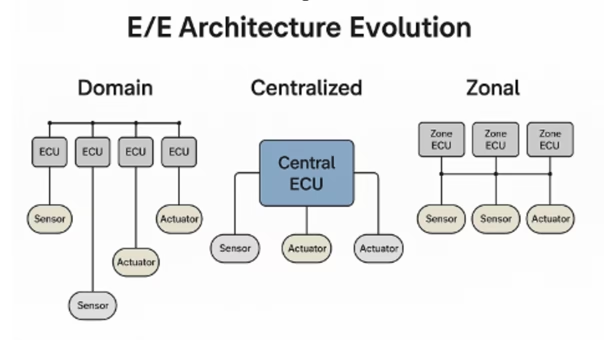
Historically, E/E systems were domain-centric, meaning separate ECUs managed distinct vehicle areas such as infotainment, body control, and powertrain. However, as vehicle complexity increased, these architectures led to growing inefficiencies—particularly in wiring, integration, and maintainability.
Today, modern strategies favor centralized architectures, where powerful central computers oversee broader sets of functions. In this model, zonal ECUs complement the central processor by aggregating sensor and actuator data at the vehicle edge. As a result, this architectural shift delivers multiple benefits:
Firstly, it reduces wiring complexity and weight.
Secondly, it enhances system flexibility and modular scalability.
Thirdly, it simplifies diagnostics and supports streamlined over-the-air updates.
Finally, it enables faster integration of new features without overhauling the entire platform.
Challenges in Executing Centralized E/E Architectures
Despite the clear strategic advantages, implementing centralized and zonal E/E architectures introduces a number of complex challenges. First, OEMs must maintain real-time performance across increasingly distributed and latency-sensitive systems. At the same time, they must manage legacy software dependencies while integrating new, modular features. Additionally, the rise in connectivity raises the stakes for cybersecurity, requiring robust frameworks at both the hardware and software levels. Supplier ecosystems also need to be realigned around unified systems engineering models to ensure consistent interface adherence. Finally, as software becomes the primary differentiator, validation complexity grows substantially—demanding new methods for continuous testing and system-level verification.
Consequently, OEMs must adopt a disciplined, systems-oriented development approach to maintain architectural integrity while scaling functionality.
The diagram below illustrates this evolution, showing how the industry is progressing from fragmented, domain-based structures to centralized and zonal architectures that promote modularity, scalability, and system cohesion.
Feature-Based Development and Systems Engineering Discipline
A foundational aspect of modern E/E Architecture is the transition to feature-based development. Rather than building systems around isolated hardware commodities, today’s OEMs begin with clearly defined, customer-centric features. Engineers then systematically break down these features into:
Functional Requirements
Logical Architectures
Software Modules
Hardware Interfaces
Systems Engineering teams lead this structured process, ensuring traceability, modularity, and reusability across platforms. Furthermore, when teams define interfaces early in development, they allow features to evolve independently—without destabilizing the broader architecture. Ultimately, this approach supports long-term updateability and accelerates deployment cycles.
Case Studies: GM, Ford, and Tesla
The varied approaches of GM, Ford, and Tesla illustrate the strategic divergence and challenges in implementing modern E/E Architecture.
General Motors (GM): GM is actively transitioning toward a centralized architecture supported by zone ECUs. However, the company continues to rely heavily on supplier-driven development. As a result, supplier dependency often weakens architectural consistency and delays the full realization of modular and scalable platform benefits.
Ford: Ford, on the other hand, has made organizational investments in Systems Engineering and is gradually pursuing centralized development. Yet, despite this structural progress, the company has delivered few visible architectural breakthroughs. Consequently, a clear gap remains between strategic intent and actual execution.
Tesla: Tesla represents the most aggressive shift toward centralization and vertical integration. It minimizes the number of ECUs and leverages software-defined features across the vehicle, enabling rapid over-the-air updates. However, this approach is not without drawbacks. Tesla’s lack of structured Systems Engineering has contributed to recurring quality and reliability issues, which the company has acknowledged through a growing number of recalls.
Real-World Impacts: Recalls and Architectural Discipline
The risks associated with weak Systems Engineering practices are not theoretical—they are already manifesting in widespread vehicle recalls. These real-world consequences illustrate how misaligned or poorly executed E/E strategies can jeopardize safety, damage brand reputation, and trigger significant financial penalties.
GM: A mismatch in brake system software and ABS calibration led to failures in over 250,000 vehicles. This highlights weaknesses in system integration and validation oversight.
Ford: The company experienced PCM-related engine stalling issues, affecting more than 123,000 vehicles. Additionally, regulators fined Ford for delays in addressing rearview camera failures—revealing breakdowns in lifecycle management and escalation protocols.
Tesla: Despite leading in centralized architecture, Tesla issued over 700,000 recalls linked to Autopilot behavior and tire pressure monitoring problems. These incidents expose gaps in validation and an over-reliance on reactive software fixes.
Ultimately, these examples underscore the urgent need for disciplined E/E governance and robust systems integration from the outset.
Key Capabilities Needed for Successful E/E Modernization
To realize the full promise of software-defined, modular vehicles, OEMs must build internal capabilities that extend beyond conventional development models. These capabilities support both smoother architectural transitions and long-term product competitiveness.
Strong Systems Engineering teams must take responsibility for aligning hardware and software integration from the outset.
Feature-based organizational structures give teams end-to-end ownership of customer-facing functions, minimizing complexity across handoffs.
Agile software development, when integrated with traditional validation workflows, accelerates iteration without compromising quality.
Security teams should embed cybersecurity frameworks early in the design—at both the feature and platform levels—to safeguard connected systems.
Lifecycle teams must define management strategies that support long-term OTA updates, feature expansion, and software versioning.
When OEMs commit to these practices, they position themselves to navigate architectural transformation and outperform competitors locked in legacy models.
Investment Lens: Opportunities in E/E Modernization
As the automotive industry embraces centralized, modular, and software-defined vehicle platforms, it creates a compelling landscape of strategic investment opportunities. This transformation is not solely technological—it actively reshapes the vendor and service ecosystem responsible for delivering future-ready vehicles.
Specifically, investors should monitor growth in the following areas:
Systems Engineering consultancies that help OEMs define interfaces, requirements, and functional decomposition.
Modular software platform providers offering scalable libraries and cloud-connected feature management.
Zonal ECU and sensor module manufacturers delivering flexible, edge-connected hardware for centralized architectures.
OTA platform developers focused on secure, incremental updates across critical systems.
Validation and integration firms specializing in automated testing and compliance under dynamic software conditions.
Consequently, OEMs that embrace these enablers gain greater agility, lower integration costs, faster feature delivery, and stronger regulatory alignment.
Conclusion: E/E Architecture - Strategy, Challenges, and Investment Outlook
In the years ahead, OEMs that master E/E Architecture will gain the defining edge in automotive competitiveness. Those that adopt disciplined, feature-driven, and modular platforms will not only excel technologically—they will also secure lasting strategic and financial advantages.
Investors who identify these operational hallmarks early will be better positioned to back the industry’s future leaders. At the same time, OEMs must recognize the stakes: evolve toward scalable, software-defined systems or risk being left behind.
As vehicles become more connected, updateable, and intelligent, the next generation of automotive innovation will be driven by the shift from fragmented control units to unified software-hardware architectures.
References
-
- NHTSA Recall Reports for GM:
https://static.nhtsa.gov/odi/rcl/2024/RCLRPT-24V674-9670.PDF
- Ford Recall Details (Reuters):
- Tesla Autopilot Issues (The Guardian):
https://www.theguardian.com/technology/2024/apr/26/tesla-autopilot-fatal-crash
- Tesla TPMS Recall (People.com):
- Infineon Radar Sensors Overview:
https://www.infineon.com/cms/en/product/sensor/radar-sensors/radar-sensors-for-automotive/
- NXP Automotive Radar Solutions:
About George D. Allen Consulting:
George D. Allen Consulting is a pioneering force in driving engineering excellence and innovation within the automotive industry. Led by George D. Allen, a seasoned engineering specialist with an illustrious background in occupant safety and systems development, the company is committed to revolutionizing engineering practices for businesses on the cusp of automotive technology. With a proven track record, tailored solutions, and an unwavering commitment to staying ahead of industry trends, George D. Allen Consulting partners with organizations to create a safer, smarter, and more innovative future. For more information, visit www.GeorgeDAllen.com.
Contact:
Website: www.GeorgeDAllen.com
Email: inquiry@GeorgeDAllen.com
Phone: 248-509-4188
Unlock your engineering potential today. Connect with us for a consultation.