Unified Data Lakes and Open Catalogs for New Vehicle Safety

Unified Data Lakes and Open Catalogs for New Vehicle Safety
Unified Data Lakes and Open Catalogs
Generally, as passive safety systems become increasingly data-driven and AI-supported, automotive OEMs face a growing challenge. Specifically, they must enable efficient, cross-functional access to evolving datasets without duplicating or fragmenting data. Fortunately, open catalogs, combined with open table formats like Apache Iceberg and Delta Lake, provide a compelling solution—creating a Unified Data Lakes accessible by engineering, AI, and validation teams.
Hence, this article builds upon the principles discussed in the earlier pieces, References below.
- Part 1: New Vehicle Safety: Improvement and Optimization of Data Logic
- Part 2: New Vehicle Safety – AI Models: From Data to Deployment
Now, we focus on unifying the underlying data structure across all functional teams.
1. The Challenge of Fragmented Data in Safety Development
Traditionally, teams working on occupant sensing, algorithm training, system validation, and regulatory compliance operate on separate data pipelines. Consequently, this leads to version mismatches, duplication, and significant overhead in aligning efforts.
Moreover, to address these limitations, Systems Engineering holistic approach: use-case modeling framework emphasizes the need for synchronized access to evolving behavioral datasets. As a result, Unified Data Lakes infrastructure becomes essential, especially as passive safety AI systems grow more complex.
2. What Open Catalogs Enable
Open catalogs like AWS Glue, Hive Metastore, or Project Nessie provide metadata management and data discovery over shared data lakes. Furthermore, when combined with open table formats, they offer several powerful capabilities:
- Centralized Metadata: Track schema changes, partitions, and access control efficiently.
- Cross-Tool Interoperability: Let Spark, Trino, Presto, and Flink users access the same datasets without conflicts.
- Version-Aware Queries: Enable accessing specific table snapshots by timestamp or version ID for precise model traceability.
Moreover, this coordination allows multiple teams to synchronize datasets for training, simulation, safety validation, and compliance documentation.
Simple Diagram Layout: Visual: Unified Data Lake + Functional Teams Diagram.
Essentially, the following structure illustrates how open table formats and open catalogs unify teams around a single trusted data lake.
Unified Data Lakes architecture for passive safety AI development, validation, and regulatory compliance, enabling synchronized collaboration across engineering, AI, validation, and audit teams:
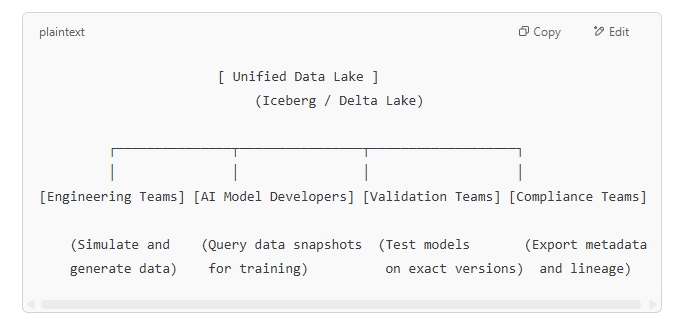
Diagram Description:
- Center: Unified Data Lakes (built with Open Table Formats)
- Surrounding arrows/teams:
- Engineering (feeds in scenarios)
- AI (queries for training)
- Validation (tests models consistently)
- Compliance (audits and exports)
This visually reinforces the value of a single source of truth across all passive safety development phases.
3. Use Case: Coordinated Safety Algorithm Rollout
For example, consider a coordinated workflow based on earlier dataset and pipeline practices:
- First, engineering teams simulate new use-case scenarios and store the data using Iceberg or Delta Lake.
- Then, AI teams query datasets via a catalog (e.g., AWS Glue) and train models with explicit snapshot links.
- Afterward, validation teams test the AI model against the exact same dataset version.
- Finally, compliance teams export metadata lineage for audit trails, especially aligned to ISO 26262 and UNECE WP.29 frameworks.
In this way, the open catalog architecture ensures synchronized development and regulatory readiness without moving or duplicating large datasets.
4. Strategic Benefits of a Unified Data Lakes
There are several key advantages to embracing a Unified Data Lakes architecture:
- Reduced Redundancy: No more copying datasets across departments or tools.
- Higher Data Trust: Enforced common definitions, schema consistency, and access governance.
- Improved Efficiency: Accelerated AI model development and validation cycles.
- Regulatory Readiness: Easier demonstration of traceability and full data lineage.
Additionally, it sets the stage for continuous learning systems, where real-world OTA feedback (discussed in the next article) can be seamlessly integrated back into the model lifecycle.
Conclusion: Unified Data Lakes and Open Catalogs
In conclusion, in the future of AI-driven passive safety, a Unified Data Lakes powered by open catalogs and open table formats will be a strategic asset. Ultimately, it enables true cross-functional collaboration while maintaining control, compliance, and scalability.
Building upon the dataset creation (Part 1) and AI development management (Part 2), the unified data approach becomes critical as OEMs prepare for system validation, feedback-driven updates, and lifecycle management (to be discussed in next article).
Therefore, OEMs that adopt this model will accelerate innovation while ensuring safety-critical integrity across the vehicle’s lifespan.
References
- Part 1: https://georgedallen.com/new-vehicle-safety-improvement-and-optimization-of-data-logic/
- Part 2: https://georgedallen.com/new-vehicle-safety-ai-models-from-data-to-deployment/
- www.georgedallen.com/development-of-a-new-ai-algorithm-a-step-by-step-guide/
- www.georgedallen.com/usecases-development-of-the-prerequisites-new-databases/
- www.onehouse.ai/blog/open-table-formats-and-the-open-data-lakehouse-in-perspective
- https://databricks.com/blog/2020/06/30/what-is-delta-lake.html
- https://iceberg.apache.org/
- https://fivetran.com/blog/the-importance-of-open-table-formats-for-modern-data-lakes
About George D. Allen Consulting:
George D. Allen Consulting is a pioneering force in driving engineering excellence and innovation within the automotive industry. Led by George D. Allen, a seasoned engineering specialist with an illustrious background in occupant safety and systems development, the company is committed to revolutionizing engineering practices for businesses on the cusp of automotive technology. With a proven track record, tailored solutions, and an unwavering commitment to staying ahead of industry trends, George D. Allen Consulting partners with organizations to create a safer, smarter, and more innovative future. For more information, visit www.GeorgeDAllen.com.
Contact:
Website: www.GeorgeDAllen.com
Email: inquiry@GeorgeDAllen.com
Phone: 248-509-4188
Unlock your engineering potential today. Connect with us for a consultation.